Back to Biology

Senses & Reaction Time Lab

Foundations
File ▾

FOUNDATIONS · YOUR NERVOUS SYSTEM

How fast can you catch a falling stick?

Your partner drops a meter stick. You catch it. Follow the signal from your eye to your brain to your hand, and measure your reaction time from how far the stick fell.
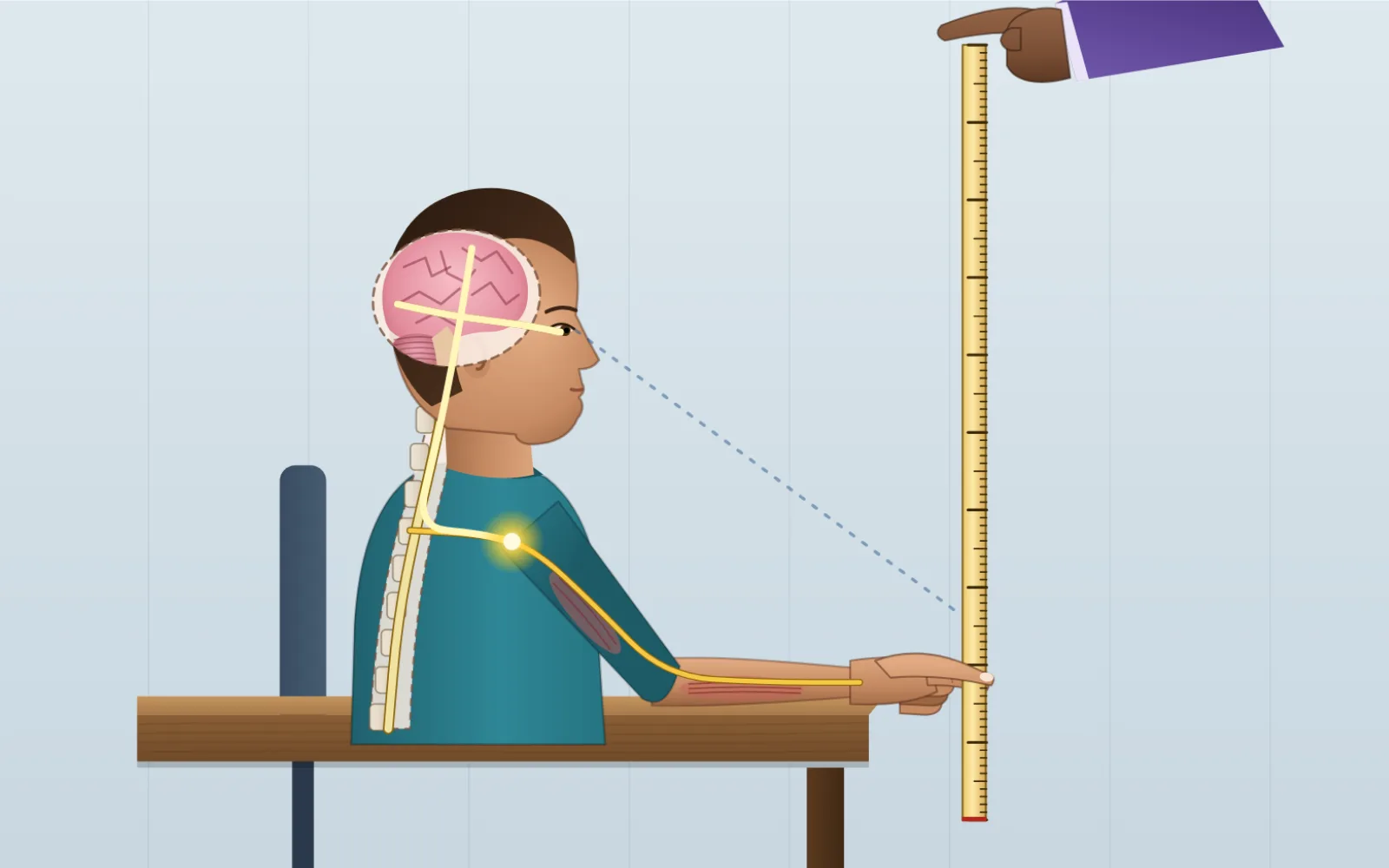
A student at a desk catches a falling meter stick; a cut-away shows the brain, spinal cord and the nerve to the arm.
  1. Press ▶ Drop the stick and watch the signal in slow motion.
  2. Read the stick in the close-up and type the number.
  3. Record it. The coach tells you what to do next.

Choose where to start:

About this model

A model, not a test of you. Real nerve signals are electrical and chemical. The picture shows the path a message takes, played 10 times slower than real life. The times are typical values; real people vary from day to day and from person to person. This is not a medical or ability test.

The path. Catch: receptor (eye, ear or skin) → sensory nerve → brain (decides to catch) → motor nerve, down the spinal cord and along the arm → forearm muscles that close the fingers. Hot-pan reflex: skin receptors → sensory nerve → spinal cord, which sends the command straight back → motor nerve → arm muscles pull the hand away. The message also goes up to the brain, so the pain is felt a moment after the hand moves.

The times in the model. A first catch with sight takes about 0.25 s; sound about 0.20 s; touch about 0.21 s. Many studies find people react a little faster to sound and touch than to sight (about 0.15–0.20 s for sound and 0.18–0.20 s for sight in simple tests), but the order and the times vary between studies and people. Practice shortens the model’s time by up to about 0.035 s over 10 trials; a second task (counting back by 7s) adds 0.065 s; the other hand adds 0.018 s; each trial also has a small ups-and-downs amount. These sizes are made up to show the idea, not measured. The hot-pan reflex takes 0.09 s.

The stick drop. The stick falls from rest, so its fall d and the reaction time t follow d = ½ g t² with g = 9.81 m/s² (air is ignored). The chart is worked out from that rule for you. A meter stick is used because a slow catch (over 0.25 s) would fall past the end of a 30 cm ruler.

Safety. Never touch a hot pan on purpose. In class, use a meter stick with a partner and keep your feet out from under it.

What am I looking at?

How the lab works. Pick Explore or one lab at the top. Each lab has five tabs: Pre-lab, Bench, Data & graph, Claim · Evidence · Reasoning, and Test. On the Bench, the coach on the right says the next step and ticks each step off as you work. Press What do I do now? if you are stuck. Press 🔊 to hear a line read aloud.

The picture. A student sits at a desk, seen from the side. A cut-away window shows the brain (pink) and the spinal cord inside the backbone (cream, with bones around it). Yellow lines are nerves. Red shapes on the arm are muscles. A partner holds a meter stick (0 cm at the bottom) between the student’s thumb and finger. When you press ▶, a glowing dot shows the signal travelling, in slow motion, while the stick falls.

Reading the stick. The close-up on the right shows where the fingers caught the stick. Read the number at the top edge of the thumb and type it. The farther the stick fell, the longer the reaction time. The stick-drop chart turns centimetres into seconds.

The reflex. Choose Hot-pan reflex to see a response that turns around in the spinal cord instead of the brain.

Keys: Space runs the bench. Enter records your reading.